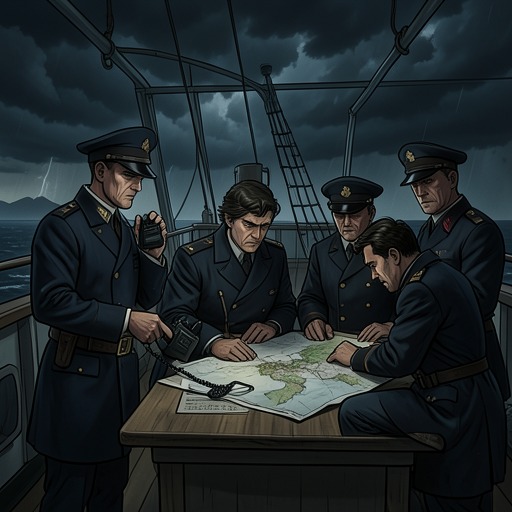
The last extremity
The Caine MutinyThe last extremity is the threshold of imminent maritime disaster argued over at Steve Maryk’s court-martial. In the courtroom, it names more than a degree of bad weather: it is the condition under which a ship may be so close to foundering that heading into the wind becomes a last chance to retain control. The testimony makes the phrase pivotal because it joins an operational judgment to a question of command authority: even if the danger is real, who decides that it has reached this extreme?
Meaning and Operational Test
The standard takes shape through a hypothetical put to a testifying captain. Jack Challee asks him to imagine a destroyer in winds and seas worse than any he has experienced, wallowing broadside, and believed by its commanding officer to be foundering. The question is not about ordinary rough weather or a generally preferred course. It deliberately places the ship at the edge of survival, where the usual certainty of a handling rule gives way to a decision made under immediate pressure.
The captain answers that, in the last extremity, he would head into the wind if he could. He explains the maneuver in practical terms: the engines and rudder would have their best purchase in that position, making it the remaining chance to keep control of the ship. The qualification matters. This is not presented as an unconditional instruction to head into the wind whenever a ship is in danger; the phrase marks a narrowly defined emergency and the maneuver is framed as an effort to preserve control when ordinary options have failed.
Challee then introduces a complication: what if heading into the wind would keep the ship in the storm instead of allowing it to escape? The witness’s answer prioritizes the immediate threat of foundering. If the ship is on the verge of going down, he argues, it is already as bad off as it can be. The exchange therefore sets two dangers against each other—remaining in the storm and losing the ship—and makes the last extremity the condition that determines which danger must take precedence.
Who Judges the Crisis
The testimony makes authority to identify the threshold as important as the maneuver itself. Asked who is best qualified to decide whether a ship has reached its last extremity, the captain answers that there is only one judge: the commanding officer. He grounds that answer in the Navy’s assignment of command, asserting that the captain’s knowledge of the sea and ships is superior to anyone else aboard. Subordinates, in his account, may mistake a frightening spell of weather for a genuinely terminal emergency.
The defense presses the opposing possibility: if all the subordinate officers agree that the ship is going down, should the captain listen? The answer is an emphatic negative. The witness describes panic as a common hazard at sea and casts command as the capacity to resist collective alarm and act on one’s own judgment. The passage thus gives the expression a built-in tension. The last extremity is described as a condition of the ship, but its presence is not established by a measurement or by agreement among the crew; in this testimony, it is for the commanding officer to determine.
That claim is not merely abstract courtroom doctrine. It bears directly on Maryk’s justification for relieving the captain: if only the commanding officer can judge that the ship is in extremis, the subordinate’s assessment risks being classified as panic rather than a reason to intervene. Conversely, if the circumstances can be assessed through observable failures, the captain’s authority may be tested against what the ship and its equipment are actually doing. The exchange makes the dispute turn on both the emergency and the legitimacy of the person interpreting it.
Maryk’s Account of the Storm
When Barney Greenwald asks Maryk whether the ship was in the last extremity on the morning of December 18, Maryk says that it was. Asked for his grounds, he does not rely on a general impression that the weather was severe. He recounts a sequence of failures: the ship could not hold course and broached three times in an hour; it rolled too steeply for the inclinometer to record; solid water entered the wheelhouse; generators cut out; lights and the gyro failed intermittently; emergency rudder and engine settings did not make the ship answer; and sea return jammed the radar. His conclusion is that they were lost and out of control.
Maryk also says that he repeatedly pointed out these conditions to the captain for an hour and begged him to ballast and head into the wind. The details answer the hypothetical with a concrete account of shiphandling, equipment, and unsuccessful warning. They also sharpen the question the court must weigh: whether Maryk’s description demonstrates the extreme condition the witness defined, or whether the authority to call that condition still belonged exclusively to the captain.
Narrative and Legal Significance
The phrase functions as both an operational limit and a contested standard of judgment. Its force lies in the conjunction of a specific maneuver with the claim that the maneuver is justified only at the point of near-foundering. The courtroom’s sequence—from the imagined destroyer, to the captain’s explanation, to the challenge about the storm’s path, and finally to the question of who judges—prevents the term from settling into a simple rule. The more precisely the witness describes the danger, the more sharply the question of command authority comes into view.
The novel places that argument within a fictional account of a court-martial arising from a captain’s relief at sea. Its prefatory note explicitly cautions that the people and events aboard the Caine are imaginary and that the book’s military details have been altered. Accordingly, the last extremity is best understood here as a standard dramatized by the novel’s testimony, not as evidence that the described proceeding or incident occurred in actual naval history. Within the story, it concentrates the larger conflict into one urgent distinction: whether an apparent catastrophe is a subordinate’s fearful misreading, or a danger so immediate that waiting for the captain’s judgment may itself imperil the ship.